
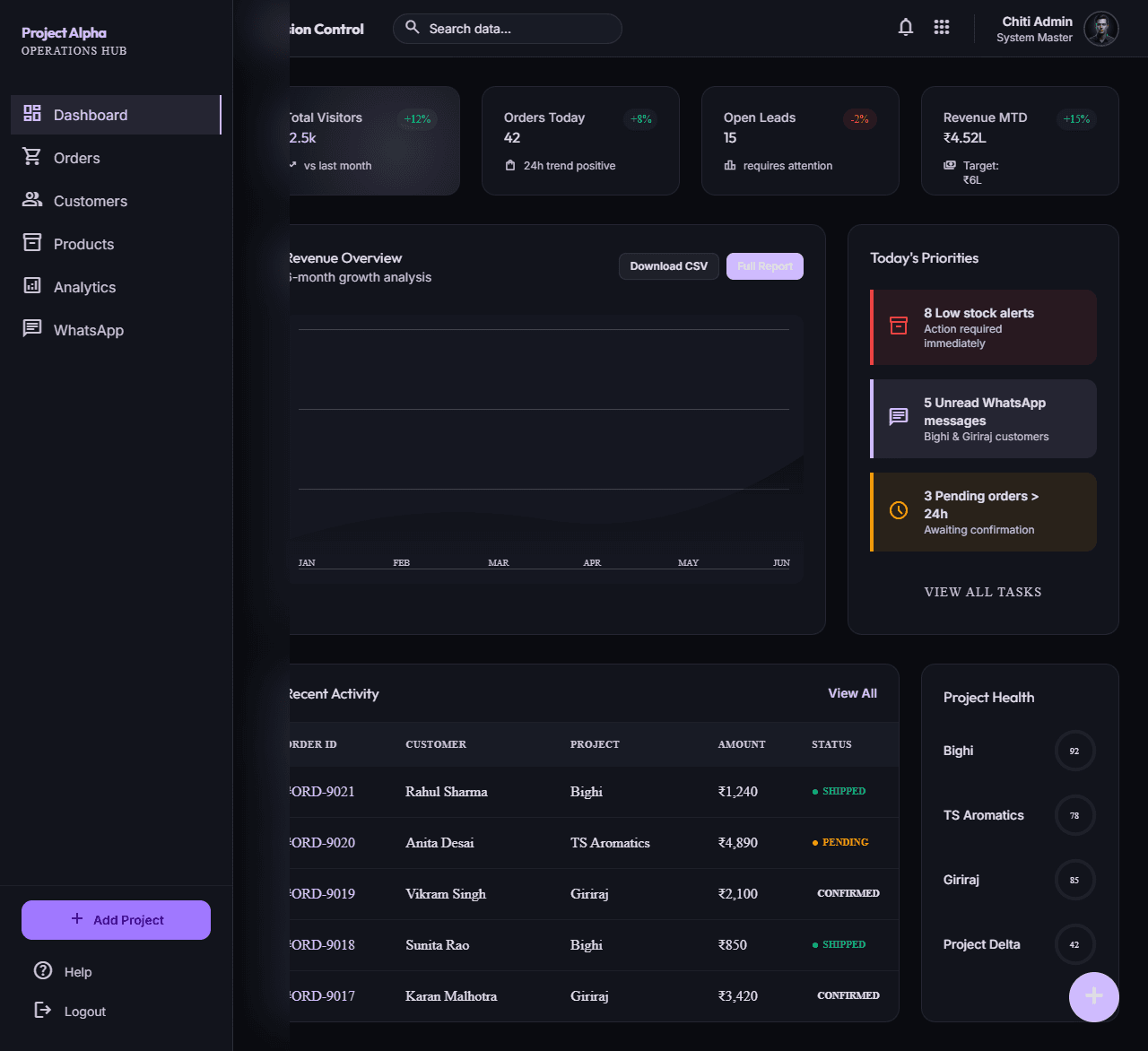
Chiti Console — Unified Operations Dashboard
A single-pane-of-glass for managing orders, customers, products, leads, finance, and content across multiple projects — powering the studio's entire operational stack.
17
Database Models
6
Capability Engines
7
User Roles
25+
Routes
Chiti Technologies was managing multiple projects — Bighi Brothers e-commerce, Jharkhand Booking marketplace, and internal operations — through disconnected tools. Spreadsheets tracked orders, separate dashboards managed products, and WhatsApp threads handled customer communication. There was no unified operational view. Staff constantly switched context, data was duplicated or lost, and leadership lacked a clear picture of the business. The challenge was not just building a dashboard — it was designing a system that could adapt to different project types while maintaining a coherent operational core.
We built Chiti Console as a multi-tenant operations platform organized around the concept of capability-based engines. Instead of a monolithic app with fixed features, the system defines 6 engines — Commerce, Marketplace, CRM, Finance, Content, Analytics, and AI — that can be activated per project based on its type (ECOMMERCE, MARKETPLACE, B2B_CATALOG, SAAS, CONTENT, CUSTOM). This architecture means the same codebase powers a product catalog for Bighi Brothers, a vendor management system for Jharkhand Booking, and a finance dashboard for the studio — each project sees only the capabilities it needs. The operating model dispatch ensures the interface adapts to each project's domain without branching the codebase.
Designing a unified system that serves radically different project types (e-commerce, marketplace, SaaS) without becoming a generic mess
Building RBAC flexible enough for 7 roles across multiple projects with different permission needs
Creating a finance module that handles both Indian (Razorpay) and international (Stripe) payment flows
Making the AI query bar genuinely useful — not a gimmick — for operations staff who are not technical
Ensuring the client portal felt secure and premium while being lightweight enough to deploy alongside the main app
Handling webhook reliability for payment notifications, WhatsApp messages, and order sync across services
How We Solved It
Capability-based engine architecture
Instead of building features for every possible use case, we defined discrete engines that can be composed per project. A marketplace project gets the COMMERCE, CRM, and ANALYTICS engines; a content project needs CONTENT and ANALYTICS. This keeps the codebase lean while allowing the system to scale to new project types without refactoring.
Operating model dispatch
Each project has an operating model (ECOMMERCE, MARKETPLACE, B2B_CATALOG, SAAS, CONTENT, CUSTOM) that determines which engines are active and how the dashboard presents data. This lets the system serve a B2B catalog (TS Aromatics) and a D2C store (Bighi Brothers) from the same interface — the only difference is the engine configuration.
RBAC as a first-class concept
We defined 7 roles from SUPER_ADMIN to CLIENT_VIEWER, each with granular permissions scoped to projects and engines. This allows the studio to give clients read-only access to their own project data while vendors see only their orders and support agents see only their assigned tickets — all within the same system.
REST API as a product feature
The API is not an afterthought — it is a designed interface with API key authentication, rate limiting, response formatting, and comprehensive error handling. This allows external projects (like Jharkhand Booking) to integrate with the Console as their backend, turning the dashboard into a platform.
AI query over dashboard complexity
Rather than building endless filter UIs and custom report builders, we added a natural language query bar powered by OpenAI. Staff can ask 'How many orders did Bighi Brothers have last week?' or 'Show me pending payments above ₹10,000' and get instant answers. This reduced the need for custom dashboard views while making data accessible to non-technical team members.
Webhook-first integrations
Payment notifications, WhatsApp messages, and order sync all flow through webhook receivers that process events asynchronously. This ensures the system remains responsive during high-volume periods and provides clear audit trails for every transaction.
The Work
The screens below show the main operational surfaces: a unified dashboard with AI query capabilities, order and customer management, and the analytics and finance modules that power the studio's business operations.

Dashboard overview — The central operations surface showing active projects, key metrics, and the AI query bar. Each project card shows its operating model and status at a glance.

Orders and customers management — Consolidated view of all orders across projects with filtering by status, payment method, and project. Customer records show full lifecycle from first enquiry to repeat purchase.

Analytics and finance — Real-time metrics dashboard with revenue tracking, order trends, and CSV export. Finance module handles invoice generation, payment reconciliation, and Razorpay/Stripe integration.
What We Delivered
Multi-project management with capability-based engine architecture (COMMERCE, MARKETPLACE, CRM, FINANCE, CONTENT, ANALYTICS, AI)
RBAC with 7 user roles — SUPER_ADMIN through CLIENT_VIEWER
Order management with Razorpay + Stripe payment processing
Customer management with full lifecycle tracking
Product catalog with multi-variant support and SKU management
Kanban lead management with drag-and-drop pipeline
Finance module with invoice generation and payment reconciliation
WhatsApp integration for automated customer communication
Content management with rich media support
Analytics dashboard with real-time metrics and CSV export
Client portal with separate JWT-based authentication
REST API with API key authentication and rate limiting
AI natural language query bar for ad-hoc data insights
Consolidated 3+ project operations into a single pane of glass — no more spreadsheet hopping or WhatsApp threads
Reduction in operational overhead — staff can manage orders, customers, and content without switching contexts
Multi-project capability allows the studio to onboard new clients without building new operational tooling
Client portal gives external stakeholders secure, read-only access to their own project data
REST API serves as the backend for external projects, turning the Console into a platform rather than a standalone tool
AI query bar makes data accessible to non-technical team members without custom report building
Production-ready system deployed on Vercel with Docker-based PostgreSQL for local development
Chiti Console became the operational backbone of the studio faster than expected. The most important architectural decision was the capability-based engine model — it lets the system serve fundamentally different project types from a unified codebase without accumulating feature bloat. The REST API decision proved particularly valuable: it transformed what could have been a simple internal tool into a platform that external projects use as their backend. If we were starting over, we would invest in the webhook infrastructure even earlier, as async event processing became critical once multiple projects were connected.
Process & Progress
Capability Engine Model
Architected the core engine abstraction that lets each project activate only the capabilities it needs. Defined 6 engine types (COMMERCE, MARKETPLACE, CRM, FINANCE, CONTENT, ANALYTICS, AI) with the operating model dispatch system that adapts the dashboard to each project's domain. This single decision prevents the codebase from becoming a monolithic mess as new project types are added.
Database Schema & Prisma Models
Designed 17 Prisma models covering organizations, users, projects, orders, customers, products, leads, payments, invoices, content, analytics, and integrations. The schema supports multi-tenancy through project-org-user relationships, with soft delete and audit timestamps across all models.
RBAC with 7 Roles
Implemented granular role-based access control with 7 roles: SUPER_ADMIN, PROJECT_ADMIN, FINANCE_MANAGER, SUPPORT_AGENT, VENDOR_USER, CLIENT_VIEWER, CONTENT_EDITOR. Each role has permissions scoped to projects and engines, allowing the same system to serve internal staff, external clients, and vendors with appropriate access levels.
Payment Processing & Webhooks
Integrated Razorpay and Stripe payment processing with webhook receivers for asynchronous event handling. The webhook layer processes payment notifications, WhatsApp messages, and order sync events, ensuring the system remains responsive during high-volume periods with clear audit trails.
REST API & Client Portal
Built a comprehensive REST API with API key authentication, rate limiting, and structured responses. The client portal uses separate JWT-based authentication, allowing external stakeholders secure access to their project data. This API layer is what allows Jharkhand Booking and other projects to use the Console as their backend.
AI Natural Language Query
Added an AI-powered query bar that lets staff ask plain-English questions about their data. Powered by OpenAI, it translates natural language into database queries and returns formatted responses. This eliminated the need for custom report builders and made data accessible to non-technical team members.
Tell us what you want to build.
Whether you need a premium website, AI workflow, or a complete digital system, Chiti can help turn your idea into infrastructure that works.